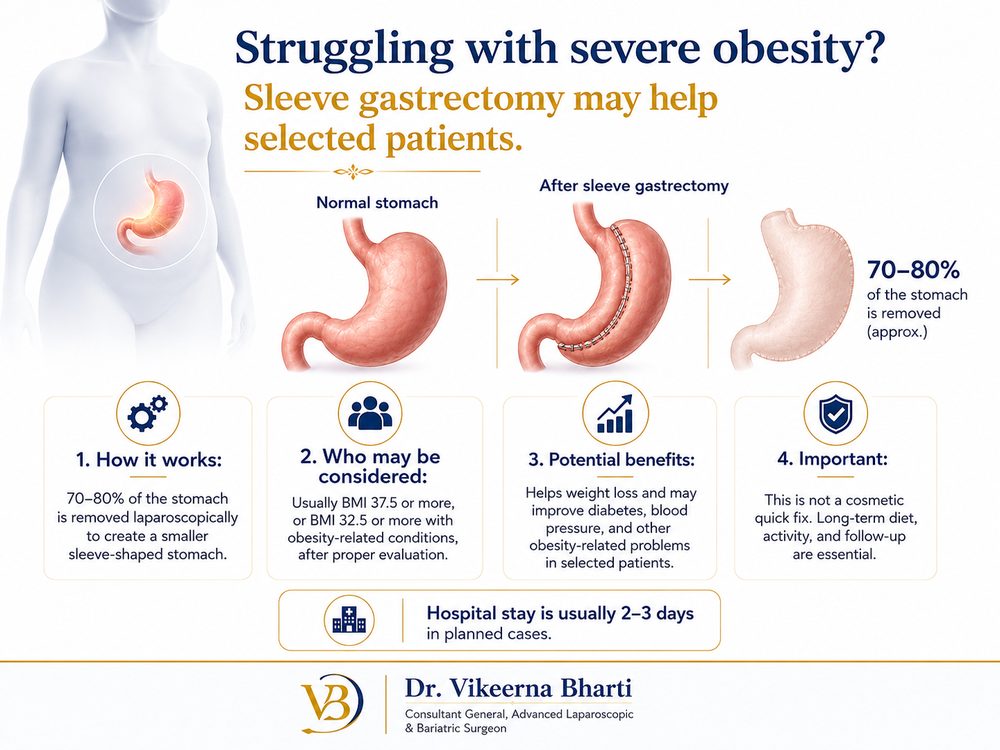
Bariatric Surgery — What You Need to Know
Bariatric surgery — also called obesity or metabolic surgery — is a clinically proven medical procedure designed to help patients with significant obesity manage their weight and associated medical conditions. It is indicated when non-surgical approaches, such as structured diets, exercise, and medical therapies, have not provided durable long-term results.
At Samford Super Speciality Hospital, Ranchi, Dr. Vikeerna Bharti performs **Laparoscopic Sleeve Gastrectomy** for patients who meet established clinical criteria after a thorough evaluation process.
मोटापा एवं मेटाबॉलिक सर्जरी — रांची
मोटापे की सर्जरी (Bariatric Surgery) कोई कॉस्मेटिक इलाज नहीं है। यह उन मरीजों के लिए है जिनका वजन अत्यधिक है और जो शुगर, बीपी या सांस की बीमारी (Comorbidities) से पीड़ित हैं। डॉ. विकीर्ण भारती रांची के सैमफोर्ड अस्पताल में लेप्रोस्कोपिक स्लीव गैस्ट्रेक्टोमी (Sleeve Gastrectomy) करते हैं। ऑपरेशन से पहले मरीज की पूरी जांच की जाती है। जानकारी के लिए संपर्क करें: +91 62060 91982
⚠️ Clinical Commitment & Eligibility Guidelines:
Bariatric surgery is a clinical tool, not a quick cosmetic fix. It requires a permanent commitment to post-operative dietary guidelines, vitamin supplementation, physical activity, and long-term follow-up. Not all patients who enquire will be eligible; surgery is only offered after a thorough evaluation.
Laparoscopic Sleeve Gastrectomy: The Procedure
Sleeve gastrectomy is a restrictive laparoscopic procedure. Approximately 75% to 80% of the stomach is removed, leaving a thin vertical tube or "sleeve" shaped like a banana. This restricts the amount of food that can be consumed at one time and causes hormonal changes (by reducing hunger-regulating hormones like ghrelin) that support metabolic improvement.
Key Clinical Facts
- Minimally Invasive: Performed via tiny keyhole incisions, ensuring less post-operative discomfort.
- Anaesthesia: Performed under general anaesthesia; typical operating time is 1 to 2 hours.
- Hospital Stay: Patients typically require a hospital stay of 2 to 3 days for monitoring.
- Irreversible: The portion of the stomach removed is permanently excised.
Who is Considered for Bariatric Surgery?
Eligibility is determined on an individual basis following a medical evaluation. Below are the standard clinical guidelines:
Additional factors evaluated include duration of obesity, previous medical weight-loss attempts, psychological readiness, and the capability to adhere to long-term follow-up and nutritional monitoring.
Evidence-Based Metabolic Improvement
Clinical studies show that bariatric surgery, in appropriately selected patients, is associated with substantial weight reduction and improvement in obesity-related medical conditions. However, **results vary between individuals** and depend on adherence to dietary guidelines:
- Weight Reduction: Significant loss of excess body weight is observed in many patients over 12 to 18 months, with individual variations.
- Type 2 Diabetes: Metabolic improvement may occur, leading to better glycemic control. The degree of improvement varies.
- Cardiovascular Health: Blood pressure and lipid profiles may improve after significant weight reduction.
- Sleep Apnoea: Obstructive sleep apnoea symptoms often improve as upper airway fatty tissues decrease.
ℹ️ Structured Bariatric Care in Jharkhand
The Metabolic and Obesity Clinic at Samford Super Speciality Hospital, Kokar Chowk, Ranchi, offers a locally accessible program with full pre-operative diagnostics, anaesthetic safety, and post-operative follow-up, eliminating the need to travel out of state.
Frequently Asked Questions
Yes. Dr. Vikeerna Bharti performs sleeve gastrectomy at Samford Super Speciality Hospital, Kokar Chowk, Ranchi, for properly evaluated and selected patients. It is one of the few centres in Jharkhand providing structured bariatric care.
Suitability is determined after a thorough evaluation. As a general guide, patients with a BMI of 37.5 or above, or a BMI of 32.5 or above with conditions like type 2 diabetes or hypertension, may be considered after a full clinical assessment.
Sleeve gastrectomy does not cure diabetes. In selected patients with type 2 diabetes and significant obesity, metabolic improvement — including better blood sugar control and reduced medication requirements — may occur after surgery. The degree of improvement varies between individuals.
The laparoscopic procedure typically takes 1 to 2 hours. The hospital stay is usually 2 to 3 days. Return to light desk work is approximately 2 to 3 weeks in most patients, depending on their recovery and individual circumstances.
No, sleeve gastrectomy is not reversible. The removed portion of the stomach is permanently excised. This is an important consideration during the pre-operative evaluation and counselling process.
Long-term follow-up is required. This includes regular clinical reviews, nutritional supplementation (vitamins and minerals), dietary monitoring, and lifestyle support for at least 2 years after surgery to ensure optimal health outcomes.
Recovery is a gradual process. Patients start with liquids, progressing to purees, and then soft solids over a few weeks. Regular physical activity, such as walking, is encouraged early on.
Follow-ups are typically scheduled at 1 week, 1 month, 3 months, 6 months, 12 months, and annually thereafter. Regular blood tests are performed to monitor nutritional status.