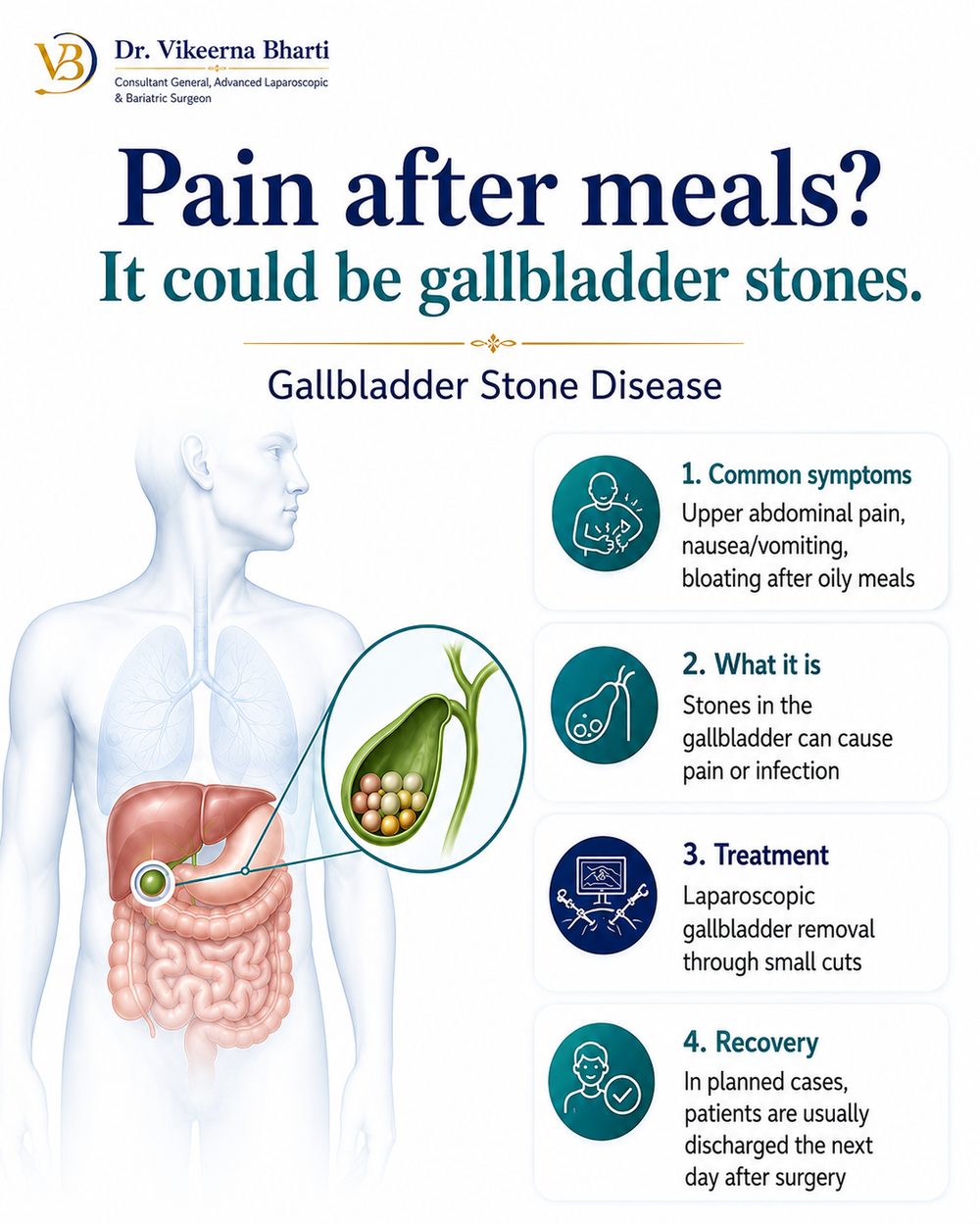
What Are Gallbladder Stones?
The gallbladder is a pear-shaped digestive organ situated beneath the liver. Its primary function is to store bile, a fluid secreted by the liver that aids in digesting dietary fats. When chemical imbalances occur in the stored bile (such as excess cholesterol or bilirubin), it can crystallise to form hard deposits known as gallstones (cholelithiasis).
These stones can vary in size from microscopic grains of sand to the size of a golf ball. While silent gallstones may cause no immediate discomfort, once they begin blocking the cystic duct, they trigger painful episodes and require surgical intervention to prevent clinical complications.
गॉलब्लेडर (पित्ताशय) की पथरी का रांची में इलाज
पित्ताशय की पथरी को केवल दवाइयों से पूरी तरह ठीक नहीं किया जा सकता है। इसके लिए गॉलब्लेडर को निकालना (Laparoscopic Cholecystectomy) ही एकमात्र स्थायी और सुरक्षित समाधान है। डॉ. विकीर्ण भारती रांची के सैमफोर्ड अस्पताल में दूरबीन विधि (लेप्रोस्कोपी) द्वारा गॉलब्लेडर का ऑपरेशन करते हैं। छोटे चीरे लगने के कारण ऑपरेशन के अगले दिन अस्पताल से छुट्टी (next-day discharge) मिल जाती है। जानकारी के लिए कॉल करें: +91 62060 91982
Symptoms of Gallbladder Stones
Many patients initially mistake gallbladder pain for simple gas or acidity. However, gallbladder symptoms are distinct and typically manifest as:
- Severe pain in the upper right abdomen, which may sharp or cramp-like.
- Pain that triggers or worsens significantly 1 to 2 hours after consuming greasy, oily, or heavy food.
- Pain radiating to the right shoulder or between the shoulder blades.
- Persistent nausea, vomiting, or deep indigestion-like bloating.
- Yellowing of the eyes or skin (jaundice), which happens if a stone slips and blocks the common bile duct.
⚠️ Seek Urgent Medical Attention If You Notice:
- Severe abdominal pain that does not subside within 2 hours.
- High fever accompanied by chills or shivering.
- Yellowing of the eyes/skin (Jaundice) or dark, tea-colored urine.
- These symptoms indicate complications like acute cholecystitis, cholangitis, or biliary pancreatitis. Call +916206091982 immediately.
Laparoscopic Cholecystectomy: The Standard Treatment
For symptomatic gallstones, surgical removal of the gallbladder (cholecystectomy) is the recommended treatment. Today, this is done via the **Laparoscopic (Keyhole) approach**, which has superseded open surgery as the clinical gold standard.
During a laparoscopic cholecystectomy, Dr. Bharti makes 3 to 4 tiny incisions (ranging from 5 to 10 mm) in the abdominal wall. A high-definition laparoscope (camera) and specialized micro-instruments are introduced through these ports. The surgeon separates the gallbladder from its attachments to the liver and bile ducts and removes the diseased organ through one of the tiny cuts. The procedure typically takes 40 to 60 minutes under general anaesthesia.
Recovery Timeline & Hospital Discharge
The minimally invasive nature of laparoscopic surgery ensures a rapid and comfortable post-operative recovery:
- Hospital Stay: Most planned laparoscopic gallbladder removals are discharged the next day.
- Mobilisation: Patients are encouraged to sit up and walk a few hours after recovering from anaesthesia.
- Pain Management: Post-operative pain is minimal and easily managed with oral medications.
- Dietary Transition: A light, liquid diet begins on the evening of surgery. Patients transition to soft foods within 24 hours, and can resume normal healthy meals within 2 to 4 weeks.
- Back to Activity: Light desk work and daily routine activities can be restarted in 5 to 7 days. Heavy lifting and strenuous exercise should be avoided for 4 to 6 weeks.
ℹ️ Can I Digest Food Without a Gallbladder?
Yes. The gallbladder only stores bile; it does not produce it. The liver continues to produce bile, which now flows directly into the small intestine in a continuous stream. Most patients experience no long-term digestive issues or dietary limitations after recovery.
Why Choose Dr. Vikeerna Bharti?
Dr. Bharti brings elite training and a patient-centric philosophy to his practice in Ranchi:
- PGIMER Chandigarh Alumni: Completed MS General Surgery at one of India's top medical training institutes.
- Former Resident Surgeon at AIIMS: Years of rigorous clinical residency dealing with complex gastrointestinal and hepatobiliary cases.
- Advanced Laparoscopic Training: Credentialed Fellowships (FMAS, FIAGES) in minimal access surgical techniques.
- Samford Hospital Infrastructure: Practises at a premier 200-bed tertiary facility equipped with advanced surgical suites and full ICU support.
Frequently Asked Questions
This is a classic symptom of gallbladder stones. The gallbladder contracts to release bile after greasy or oily meals. If stones are present, this contraction can trigger severe pain in the upper right side of the abdomen, sometimes radiating to the back. A medical ultrasound is required for evaluation.
The cost of laparoscopic cholecystectomy at Samford Hospital, Ranchi depends on factors like the type of hospital room selected, complexity of the case, and diagnostics. Dr. Bharti provides transparent billing information during clinical consultations.
No. Medicines and dietary changes can temporarily relieve symptoms but cannot dissolve or remove gallstones. Once symptoms start, surgery is the only definitive treatment to prevent severe complications.
Yes. Laparoscopic cholecystectomy is a highly common and safe procedure when performed by an experienced surgeon. Dr. Vikeerna Bharti performs this under general anaesthesia at Samford Super Speciality Hospital using advanced laparoscopic systems.
Most planned laparoscopic gallbladder removal cases are discharged the next day. The minimally invasive keyhole technique ensures less post-operative pain, quick mobilisation, and rapid recovery.
Immediately after surgery, patients start with a light, low-fat diet (dal, khichdi, boiled rice) for the first 1 to 2 weeks. The liver continues to secrete bile directly into the intestine, allowing most patients to resume a normal diet within 4 to 6 weeks.
Acute cholecystitis is severe gallbladder inflammation, often caused by a stone blocking the neck of the gallbladder. It leads to persistent pain, fever, and infection. In such cases, prompt laparoscopic cholecystectomy is indicated.
No, because the entire gallbladder is removed along with the stones during a cholecystectomy. Removal of the organ eliminates the site of stone formation.
Open surgery requires a large abdominal cut. Laparoscopic (keyhole) surgery utilizes 3 to 4 tiny incisions (5-10 mm each) to insert a camera and instruments. This leads to less pain, minimal scarring, and faster recovery.